


If you are new to the software-as-a-service (SaaS) industry, browsing through a modern B2B software directory can feel overwhelming. You will see thousands of tools promising to automate marketing, track customer pipelines, or manage workflows.
However, beneath the surface of today’s web, a major architectural shift is occurring: the rise of White-Label SaaS platforms. For directory operators, developers, and entrepreneurs, understanding how white-label platforms function—and how directories map them—is essential to navigating the software landscape. This guide breaks down exactly what white-label SaaS is, how it works under the hood, and why B2B software directories treat it differently.
1. What is White-Label SaaS?
To understand white-label SaaS, it helps to look at a traditional brick-and-mortar example. When you buy store-brand milk or generic over-the-counter medicine at a supermarket, that grocery chain did not build a dairy farm or a pharmaceutical lab. Instead, they purchased a high-quality product from a mass manufacturer and applied their own store label.
In the digital world, White-Label SaaS works the same way:
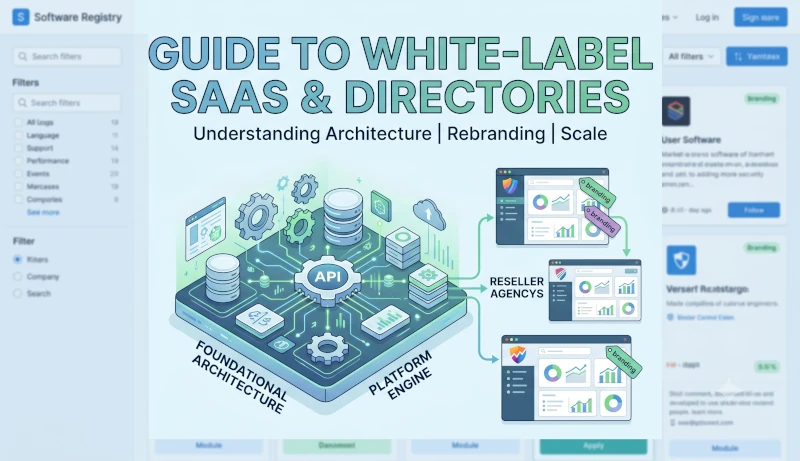
- The Developer (The Parent Architecture): A software company builds a powerful application, such as a CRM, a website builder, or an email automation tool.
- The Reseller (The Agency or Operator): Instead of selling directly to end-users, the software creator licenses the entire platform to marketing agencies or enterprise operators.
- The Rebranding: The reseller completely strips away the original creator’s branding. They apply their own logo, map it to their own custom web domain, customize the styling, and sell it to their business clients as their own proprietary software.
2. The Mechanics: How It Works Under the Hood
True white-label SaaS relies on specific technical configurations to keep the parent platform completely invisible to the end client. When inspecting these assets inside a technical matrix, directory managers look for three foundational metrics.
| Core Architectural Component | Technical Execution Method | Purpose & Operational Impact |
|---|---|---|
| Custom Domain Mapping | CNAME & DNS Routing Records | Removes the parent URL footprint completely so clients log in directly through an agency subdomain like app.yourbrand.com. |
| Multi-Tenant Infrastructure | Isolated Database Sub-Accounts | Separates client database instances safely beneath a central master administrator panel dashboard. |
| Sub-Billing Gateway Integration | Stripe Connect Automated Pipelines | Allows resellers to instantly upgrade client billing tiers, handle automated SaaS rebilling, and retain 100% of profit margins. |
3. Parent Architectures vs. Wrapper Sub-Services
As white-label platforms have exploded in popularity, it has created a unique challenge within B2B directories. The market is now split into two main layers that must be clearly distinguished in the system loop.
Foundational Parent Architectures
These are the infrastructure giants that build the core engines from scratch. They provide the heavy-lifting databases, multi-tenancy environments, and complex API integrations. A prime example of this tier is the comprehensive GoHighLevel White-Label Platform, which allows agencies to launch their own branded software ecosystems without writing any baseline code.
Wrapper Sub-Services (Extensions)
These are smaller micro-SaaS applications or specialized plugins built specifically to bolt onto a parent architecture. They add minor features, cosmetic layout dashboards, or unique industry presets to an existing engine. They cannot run independently and require the parent software structure to exist.
4. Why Registry Mapping Matters for Modern Directories
For a modern B2B software directory or web registry, a standard listing format is no longer enough. If a business is looking for a software foundation to build upon, a directory must clearly map technical metadata to ensure transparency. You can study how these structures are built natively by reviewing the WordPress Custom Post Type Documentation, which serves as the framework for building clean directory loops.
When evaluating a software asset inside a data directory, you must analyze three clear technical parameters:
- True White-Label Verification: Does the software allow for complete custom CSS overrides and total removal of parent branding, or does it leave footprint indicators in the compiled source code?
- Entry Cost vs. Scale Margin: What is the baseline barrier to entry, and does the pricing structure scale cleanly as the reseller adds more sub-accounts?
- Target Industry Alignment: Is the software designed broadly for local lead generation, or is it specifically optimized for niche industries like boutique consultancies or medical practices?
Conclusion
The shift toward white-label SaaS has completely lowered the barrier to entry for software ownership. Entrepreneurs no longer need a massive team of full-stack developers to provide enterprise-grade tools to their target industries. By accurately categorizing and tracking these foundational software systems alongside their wrapper sub-services, modern directory ecosystems give buyers the precise transparency they need to build their digital businesses on a rock-solid software foundation.

Leave a Comment