

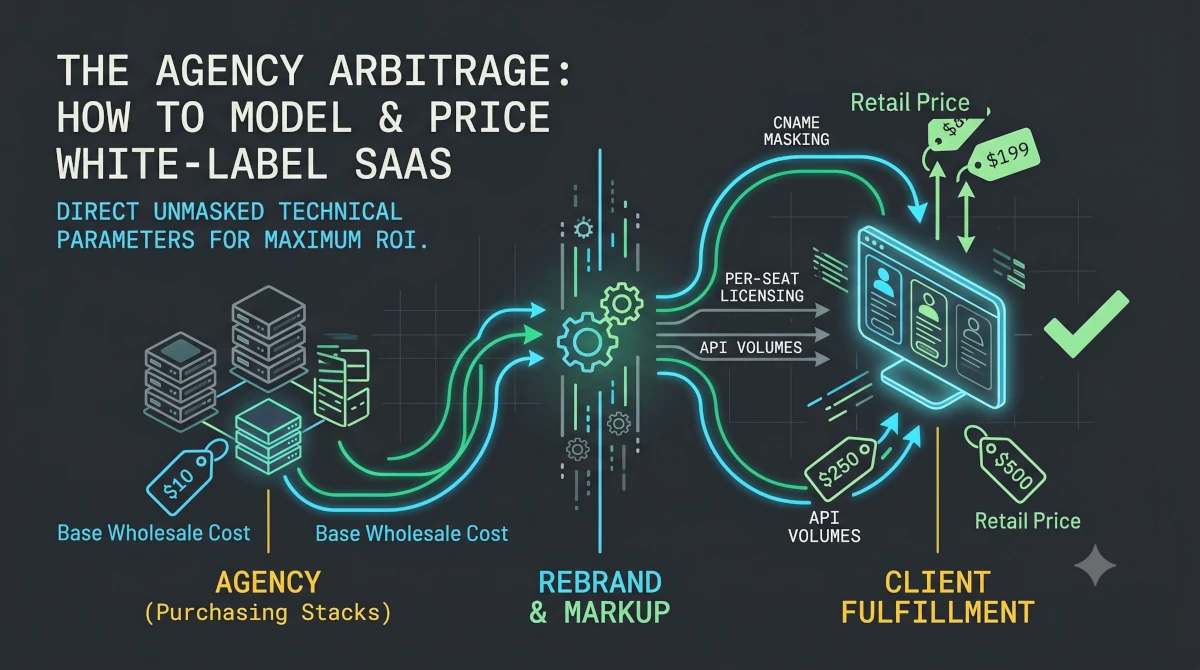
For scaling digital marketing agencies, true white-label software represents the ultimate operational shortcut. It allows you to take an enterprise-grade platform, completely mask its origin footprint, brand it as your proprietary technology, and resell it to your clients.
But behind the excitement of launching a new “proprietary” agency portal lies a critical financial challenge that trip up many founders: The SaaS Pricing Trap.
Too many agencies pick an arbitrary price point for their newly branded platform (e.g., matching a competitor or guessing a flat monthly fee) without calculating the real underlying software economics. If your software pricing model doesn’t account for seat-licensing escalations, API volume walls, or client churn thresholds, a successful client acquisition run can actually shrink your agency’s net profit margins.
To build a sustainable, high-yield software stack, you need to master the math of B2B software arbitrage. Here is how to deconstruct vendor cost structures and model your white-label pricing for maximum profitability.
1. Identifying the Underlying Cost Drivers
Before you can price your portal, you must look past the vendor’s basic marketing tier page and audit their exact billing triggers. SaaS platforms typically scale their pricing using one of three structural methods. Your white-label pricing model must directly account for whichever trigger your provider uses:
Per-Seat / User Licensing: The vendor charges you a fixed monthly fee for every active client user or employee seat created inside the dashboard (e.g., $15/user/month).
The Trap: If you charge your client a flat monthly fee for the portal, but that client adds twenty internal team members, your underlying software cost will skyrocket past the revenue you are taking in.
Usage / Metrical Volumetrics: The software bills based on strict operational data consumption—such as API calls executed, automated text messages sent, minutes of cloud telephony routing, or gigabytes of file storage utilized.
Flat Tenant Provisioning: The rare, elite agency tier where the vendor charges a flat, static platform fee for unlimited sub-accounts or allows you to purchase isolated client databases in bulk at steep wholesale discounts.
2. Choosing Your White-Label Pricing Architecture
Once you understand your true cost boundaries, you can deploy one of three core pricing frameworks to protect your margins:
Model A: The Bundled Infrastructure (The “Invisible Tech” Strategy)
Instead of itemizing the software as a separate line item on your client invoices, you absorb the cost of the white-label license directly into your premium monthly service retainer (e.g., SEO management, full-service ad placement, or operational fractional fractional consulting).
When to use it: Ideal when the software’s primary value is proving the results of your manual agency labor (such as a custom client dashboard or reporting node).
The Advantage: It elevates the perceived value of your core agency services, making your retainer sticky and incredibly difficult for a client to cancel.
Model B: Value-Based SaaS Markup (The Pure Arbitrage Strategy)
You sell the software as a standalone, proprietary app platform under your own brand, charging a clean, predictable monthly subscription price that includes a built-in margin layer.
To protect your bottom line, you must target a minimum 3x Multiplier on your baseline software costs. If a user account costs you $20/month from your vendor, your baseline consumer subscription price must start at $60/month. This 66% gross margin buffer absorbs client payment processing fees, routine customer support team time, and localized configuration overhead.
Model C: Metered Utility Passthrough (The Scalable Developer Strategy)
If your white-label stack relies on usage metrics (like SMS volumes or cloud calling minutes), your client pricing must scale dynamically alongside their consumption metrics.
The Blueprint: You negotiate custom wholesale rates with your vendor (e.g., $0.005 per API call), and you configure your app billing parameters to charge your client a retail rate (e.g., $0.015 per API call).
The Outcome: Your revenue automatically scales in perfect, locked alignment with your client’s business growth, ensuring you never get stuck holding the bill for high-volume data loops.
3. Calculating the True Break-Even Point
Before writing code or pushing a listing live, map your financial variables into a simple break-even calculation spreadsheet matrix:

For example, if a premium white-label platform charges you a foundational platform fee of $299/month to unlock white-label domain masking, and every client user account costs an additional $10/month, your variables look like this if you sell the service at $50/month:

Knowing this exact threshold prevents your agency from burning capital during the initial deployment phase. It gives your sales team an absolute, clear target number of accounts needed to transform a software infrastructure cost into a high-margin revenue engine.
Verifying the Infrastructure Before the Price
A beautiful pricing model is useless if the underlying software architecture fails under production loads. If a platform lacks true multi-tenant session isolation or allows original vendor leaks to expose your brand, your pricing strategy won’t save you from client churn.
At WebPopulous, we bypass the surface-level marketing plans and audit the raw, technical data points that dictate real-world profitability. We track the unmasked parameters that matter—from entry-tier licensing barriers to native sub-account billing engines—giving agency operators the definitive relational data pool needed to engineer invisible, high-margin software stacks.