

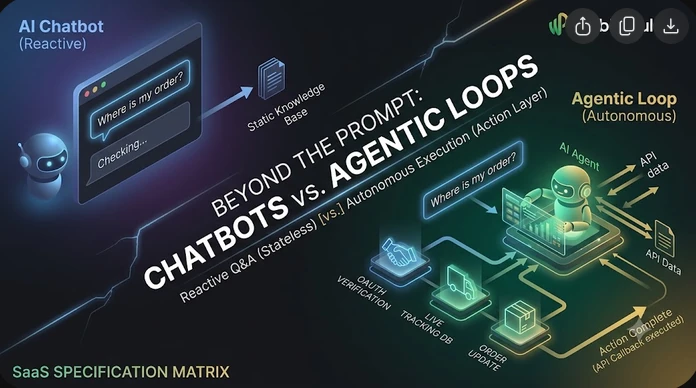
Walk through any SaaS marketing page today, and you will see the exact same buzzword plastered across every header: “Powered by AI Agents.”
The software industry has a major language problem. In a rush to capture enterprise valuations, legacy vendors have started rebadging standard, reactive FAQ chat components as “autonomous agents.”
But for technical architects, automation engineers, and digital agency operators, treating a chatbot and an agentic system as the same thing is a costly mistake. The gap between them isn’t a minor feature update; it is an entirely different software paradigm.
At WebPopulous, we refuse to let marketing hype pollute our index layers. Here is the objective, architectural breakdown of why a chatbot is not an agent, and how we draw the line in our technical specifications matrix.
The Stateless Chatbot: Reactive Q&A
A traditional AI chatbot—even one supercharged with a vector database for Retrieval-Augmented Generation (RAG)—is fundamentally a text-in, text-out machine.
It operates on a single-pass, reactive feedback loop:
- A user triggers the sequence by sending an inbound prompt.
- The chatbot searches a fixed, local folder of knowledge base documents.
- It generates an answer and pushes a block of text back to the screen.
The Hard Ceiling: The chatbot is entirely passive. If a customer asks your help desk, “Can you upgrade my subscription to the Pro tier and route my billing to a new card?”, a chatbot can only pull up an instruction document and tell the user how to do it themselves. It cannot alter database states, it has no persistent memory outside the current session, and it cannot talk to external tools without a human pulling the levers.
The Agentic Loop: Autonomous Execution
Agentic AI introduces a completely different engineering loop. Instead of being given a prompt, an agent is given a goal.
An agent operates using an active framework called a ReAct loop (Reason, Act, Observe). It doesn’t just output a response; it plans and executes multi-step tasks across isolated third-party platforms autonomously.
A true Agentic Loop looks like this:
- Understand: Grasp the high-level goal (e.g., “Reconcile failed client onboarding folders”).
- Reason: Determine the next necessary step.
- Act: Call a live API tool, execute a secure database write, or check an OAuth payload state.
- Observe: Analyze the external system’s response, adjust course if an error occurs, and iterate until a verifiable stopping condition is achieved.
See: https://www.youtube.com/watch?v=UC5LYvrapUw
When an action-taking agent runs into that same subscription upgrade request, it leaves the chat window entirely. It queries your billing ledger (like Stripe) via API, updates the client’s tier, modifies the account constraints, updates your internal CRM, and returns to the interface to report that the infrastructure modification is complete.
Side-by-Side Architectural Specifications
To keep things unbundled, here is how the specifications map out on a technical grid:
| Architectural Dimension | AI Chatbot (Reactive) | Agentic AI (Proactive) |
| Primary Trigger | User must manually submit a prompt. | Initiated by schedules, Webhooks, or high-level goals. |
| Autonomy Level | Low. Operates strictly within predefined scripted structures. | High. Independently evaluates options and maps multi-step plans. |
| System Integration | Shallow. Displays data from a single CRM or helpdesk. | Deep. Bi-directional read/write across multiple database layers. |
| Pricing Model | Predictable, standard per-user seat software pricing. | Unbundled usage-based pass-through or cost-per-outcome metrics. |
See: https://newmarketpitch.com/blogs/news/agentic-ai-market-size
How WebPopulous Filters the Noise
We don’t look at a vendor’s marketing copy to decide where it belongs in our directory. We audit the underlying data pipeline.
If a platform only supports single-turn Q&A text boxes, it is mapped cleanly into our AI Support & Chat Assistants index. But if it utilizes background multi-agent orchestration, persistent state memory, and bi-directional API task execution, it receives our structural Agentic AI tag.
We build our specifications matrix this way because we value your time. When an agency developer is trying to build an automated operational pipeline, they don’t need a list of tools that can talk—they need an index of tools that can execute work.
Skip the marketing noise. Filter by actual capability.
sources: https://www.mindstudio.ai/blog/four-levels-ai-automation-chatbots-to-agentic-systems-2 https://heeya.fr/en/blog/ai-agent-vs-chatbot-key-differences-2026 https://www.groovyweb.co/blog/ai-chatbots-vs-agentic-ai-real-difference https://viston.tech/compare-ai-agents-vs-chatbot-solutions-in-2026-a-complete-guide-for-modern-ai-chatbot-development/
8 comments on "Beyond the Prompt: Chatbots vs. Agentic Loops in SaaS Architecture"
This is a solid architectural breakdown. The distinction between stateless chatbots and true agentic loops is exactly what gets blurred by marketing hype. For anyone building real SaaS workflows, the ReAct loop (Reason, Act, Observe) is the key differentiator—it’s about execution, not just conversation.
If you’re exploring how AI can move beyond text generation into actual media production, check out Flux AI Video. It applies a similar agentic philosophy to visual content: generating images, videos, and synchronized audio from a single prompt, autonomously. A useful complement to the agentic architecture discussion.
This is a solid breakdown of the distinction between reactive chatbots and true autonomous agents. For anyone building at the intersection of AI and video production, the same principle applies—a simple text-to-video prompt is just the start. The real power comes from agentic loops that can plan, render, and iterate on complex cinematic sequences without manual hand-holding. If you’re exploring how to move beyond single-pass generation into a more autonomous creative workflow, you should check out wan3video.app. It focuses on transforming text and images into high-quality video output, which is a great practical example of moving from a basic prompt to a more dynamic, tool-driven pipeline.
The distinction between reactive chatbots and true agentic loops is spot on. Too many platforms slap “AI agent” on a simple Q&A bot without the autonomous execution layer. For teams building real SaaS architectures, understanding this gap is critical to avoid costly misconfigurations. By the way, if you’re looking to enhance your AI-driven user experiences with natural voice interactions, you might find this text-to-speech generator useful: SpeechGeneration — it converts text into lifelike audio, perfect for adding a human touch to your agentic outputs.
The distinction this article draws between reactive chatbots and true agentic loops is spot-on. As someone who works with AI-generated content daily, I’ve seen how easy it is to conflate “automation” with actual autonomous execution. This architectural clarity is exactly what teams need before building.
For those of us dealing with AI outputs, a similar precision is needed when handling the text itself. Claude-generated content often carries hidden Unicode watermarks and subtle artifacts that can compromise data integrity downstream. I’ve found that running outputs through a detection tool like claudewatermarks.com helps maintain that same level of rigor—ensuring the content you’re feeding into your agentic loops is clean and traceable. It’s a small step that aligns with the engineering discipline this article advocates.
The push to label every standard LLM wrapper as an “agent” has made SaaS marketing pretty noisy lately. There is a massive structural difference between a simple single-turn prompt call and an actual architecture that monitors state, validates output, and iterates through a workflow until a condition is met.
I run into a similar distinction on the video production side. People expect a single prompt to magically solve an entire scene, but I get far cleaner results breaking things down into controlled steps. With Kling 4.0, feeding this AI video generator a fixed end keyframe for a slow camera tilt down to a workbench usually takes two or three generations to dial in the physics, but managing the sequence in discrete stages beats hoping an algorithm guesses the entire context in one go.
Great breakdown of the chatbot vs. agentic loop distinction. The point about stateless RAG being passive while true agents execute multi-step tasks via ReAct loops is spot on. It reminds me of how the same paradigm shift is happening in creative tooling—take music source separation, for example. Instead of a reactive text-in/text-out demo, Demucs Online runs the full Demucs v4 model on cloud GPUs, so you upload a track and get isolated vocals, drums, bass, and other stems in about a minute. No local Python, PyTorch, or GPU setup required. That’s the agentic mindset applied to audio: goal in, verifiable output out.
Great breakdown of the chatbot vs. agentic loop distinction. The point about stateless RAG being mistaken for true autonomy really resonates—most “AI agents” in SaaS today are still just reactive text machines with a vector store bolted on. The ReAct loop framing is a solid architectural lens. On a related note, I’ve been testing Kling 4 for AI video generation, and it’s a good example of a tool that actually executes multi-step pipelines (text-to-video, image-to-video, native audio) rather than just returning a single prompt response. Worth a look for anyone tracking real agentic execution in creative tooling.