

When evaluating a Foundational Parent Infrastructure Hub to anchor an agency’s software stack, decision-makers often focus on superficial features: white-label branding depth, UI customization, and native integration lists.
However, for technical architects managing enterprise client portfolios, the most critical evaluation vector lives deep within the database schema: Multi-Tenant Data Isolation.
As an agency scales to hundreds of sub-accounts—each hosting sensitive customer leads, private financial ledgers, and proprietary automation pipelines—a failure in account boundary enforcement can be catastrophic. Understanding how a parent architecture structures its underlying database determines whether your platform is built for enterprise-grade security or vulnerable to accidental cross-account data leaks.
Here is an architectural breakdown of multi-tenant isolation mechanics and how to audit a parent system before committing your agency’s data infrastructure.
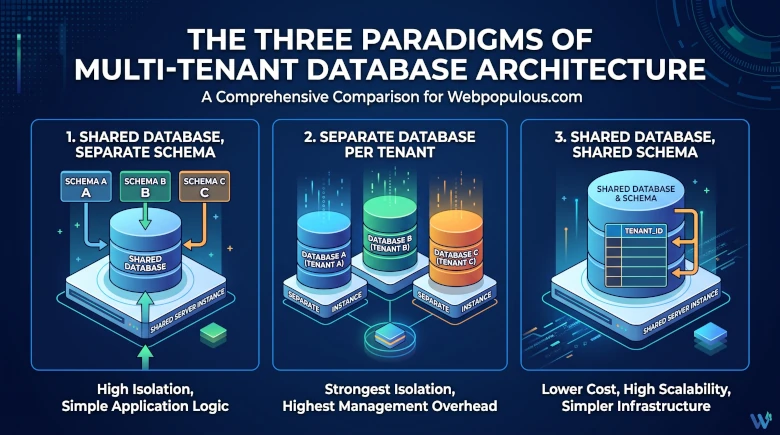
The Three Paradigms of Multi-Tenant Database Architecture
| Architecture Model | Primary Isolation Mechanism | Security & Isolation Boundary |
|---|---|---|
| Single-Database / Shared-Table | Row-Level Logic (tenant_id) | Shared Table (Requires Strict Row-Level Logic) |
| Multi-Schema / Isolated Tables | Dedicated Database Schema per Tenant | Schema Isolation (Schema: Tenant_A, Schema: Tenant_B) |
| Dedicated Isolated Databases | Air-Gapped Physical/Instance Database | Instance Isolation (DB: Tenant_A, DB: Tenant_B — Maximum Security) |
In a multi-tenant environment, multiple distinct client accounts (tenants) share the same underlying hardware and software infrastructure. How the parent platform isolates tenant data within the database layer generally falls into three structural patterns:
1. Single-Database, Shared-Table (Row-Level Security)
In this model, all clients store their records inside the exact same global database tables. Every single record—whether a CRM contact, an invoice, or an API key—is appended with a unique identifier field (e.g., tenant_id or agency_subaccount_id).
- How It Works: The application code is responsible for injecting a mandatory
WHERE tenant_id = 'X'filter into every single database query. Modern engines enforce this using database-level Row-Level Security (RLS) policies. - The Risk: If a developer updates an internal API endpoint or writes a custom database hook and forgets to enforce the
tenant_idconstraint, one client could inadvertently query or overwrite another client’s database records.
2. Multi-Schema, Isolated Tables
Instead of mixing all records inside a shared table, the parent architecture assigns a dedicated database schema or private set of tables to each sub-account within a shared database instance.
- How It Works: When Sub-Account A executes a read request, the database connection is explicitly scoped to
schema_tenant_a. - The Benefit: Accidental data leakage via missing
WHEREclauses is virtually impossible because the query execution context physically cannot access tables insideschema_tenant_b.
3. Dedicated Database Instances (Air-Gapped Isolation)
Reserved for high-compliance enterprise hubs, this approach provisions an entirely separate, isolated database instance for every tenant.
- How It Works: The parent dashboard acts as an administrative orchestrator, routing API calls and user authentication sessions to physically isolated server endpoints.
- The Benefit: Complete physical data isolation, dedicated compute resources, and zero risk of cross-account data contamination.
Comparing Isolation Paradigms
| Architectural Dimension | Shared-Table (RLS) | Multi-Schema | Dedicated Databases |
| Security Risk Profile | Moderate (Relies on strict code/RLS logic) | Low (Isolated table boundaries) | Extremely Low (Air-gapped physical isolation) |
| Infrastructure Cost | Highly Cost-Effective (High tenant density) | Balanced | High (Requires dedicated server compute per account) |
| Data Migration / Backup | Complex (Requires extracting filtered rows) | Moderate (Per-schema export) | Simple (Independent database dump) |
| Ideal Use Case | Mass SMB SaaS & High-Volume Agencies | Mid-Market B2B Platforms | Enterprise, Medical, & Financial Clients |
Key Parameters for Auditing Parent Architecture Security
Before migrating your agency’s operations to a core infrastructure platform like GoHighLevel or SuiteDash, audit the system against these technical security requirements:
- Role-Based Access Control (RBAC) Isolation: Verify that user permissions are strictly scoped at the sub-account container level. An agency team member assigned to Client A must never inherit administrative visibility over Client B’s webhook logs or API communication queues.
- API Key & Webhook Token Scoping: Ensure that API credentials generated within a sub-account are restricted strictly to that specific tenant container. If a client extracts their local API key, it must be programmatically impossible for that key to execute global queries against parent-level endpoints.
- Automated Sub-Account Sanitization: When deploying pre-built agency snapshots or industry templates from a master account down to a sub-account, confirm that the deployment engine strips out all master account environment variables, private API credentials, and historical tracking IDs.
Architectural Summary
Choosing a master parent framework requires evaluating database safety alongside marketing features. By auditing how a parent architecture handles multi-tenant data isolation, agency leads can protect their clients’ privacy, ensure long-term regulatory compliance, and build a software operation designed to scale safely.
To compare multi-tenant structures, white-label depths, and baseline entry costs across leading parent hubs, explore our updated comparison matrices on WebPopulous.
Leave a Comment