

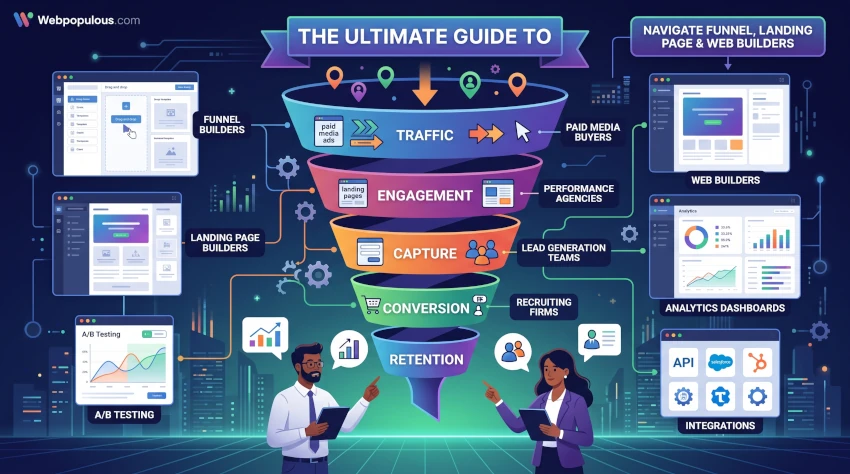
If you run paid traffic campaigns, scale performance lead-gen pipelines, or manage high-volume recruiting funnels, you already know the fundamental law of digital acquisition: Driving clicks is easy; engineering conversion is hard.
Yet, when agency teams go shopping for software inside the Funnel, Landing Page & Web Builders category, they are routinely met with marketing bloat. Traditional review sites lump lightweight AI page builders, heavy enterprise CMS platforms, embeddable developer SDKs, and mobile-native quiz funnels into the exact same bucket.
At WebPopulous, we unbundle software by examining underlying database behaviors, custom domain capabilities, rendering speeds, and conversion mechanics.
Here is how modern performance operators—including media buyers, lead-gen agencies, and recruiting firms—evaluate landing page architectures to maximize their return on ad spend (ROAS).
1. Performance Marketing & Paid Media Buyers: The Need for Speed & Dynamic Personalization
For media buyers spending tens of thousands of dollars a day on Meta, Google, or TikTok Ads, conversion rates dictate profit margins. If a landing page takes more than 2 seconds to render on a mobile network, drop-off rates surge exponentially.
Media buyers require platforms built around two technical pillars: Server-Edge Delivery and Dynamic Content Replacement.
- The Architectural Need: When running ad groups targeted at specific keywords or geographic regions, media buyers cannot afford to build 50 separate static pages. They rely on platforms like Unbounce to execute Dynamic Text Replacement (DTR). DTR dynamically swaps out page headlines in real-time to match the exact search phrase the user typed into Google, instantly boosting ad relevance scores and lowering CPCs.
- Matrix Specs That Matter:
webpopulous_true_whitelabel(for mapping custom client tracking subdomains) and high-concurrency A/B testing frameworks.
2. Lead Generation Specialists: Interactive Friction & Qualification Loops
For pay-per-lead (PPL) agencies and B2B lead generation specialists, raw form completions are no longer enough. Advertisers demand qualified leads—meaning the user must be vetted before their contact record enters the CRM.
Standard 3-field static forms fail here because they either collect too much junk or create too much drop-off friction.
- The Architectural Need: Lead-gen operators rely on multi-step, interactive quiz funnels. Platforms like Perspective approach funnel building through a mobile-first, micro-step methodology. By asking users 3 to 5 interactive, tap-based qualification questions before asking for a phone number or email, these engines psychologically prime the user to complete the form, resulting in drastically higher conversion rates and superior lead data quality.
- Matrix Specs That Matter:
webpopulous_multi_tenant(for isolating client lead pipelines into individual client workspaces) and native webhook speed (to route qualified leads to clients instantly before lead decay sets in).
3. High-Volume Recruiting Firms: Mobile-First Candidate Ingestion
Recruiting agencies and talent acquisition teams face a unique friction point: candidates do not fill out long job applications on desktop computers anymore. Over 75% of job seekers click through social ads or job board links directly from their mobile phones.
When a recruiting firm forces a candidate to upload a PDF resume or navigate a desktop-era ATS portal on a mobile browser, abandon rates skyrocket.
- The Architectural Need: Modern recruiting setups deploy lightweight, chat-style or swipe-based application funnels. By replacing rigid job application forms with mobile-optimized interactive funnels (using utilities like Weblium or Perspective), candidates can answer core pre-screening questions (e.g., certifications, availability, years of experience) in under 60 seconds directly from their phone.
- Matrix Specs That Matter:
webpopulous_entry_cost(predictable cost scaling when managing hundreds of local job-opening sub-pages) and lightweight native CRM layers to track applicant pipeline states.
Comparing the Operational Models
To help you choose the right architectural fit for your agency, here is how the primary paradigms in this category stack up:
| Operational Metric | Standalone CRO Engines (e.g., Unbounce) | Mobile-First Quiz Funnels (e.g., Perspective) | White-Label Reseller Suites (e.g., Simvoly) |
| Primary Target User | Paid Media Buyers & PPC Search Teams | Performance Lead-Gen & Recruiters | Agencies Reselling Tech to Clients |
| Core Conversion Driver | Dynamic Text Replacement & AI A/B Traffic Routing | Multi-Step Qualification Quizzes & Tap UX | Complete Site, Funnel & Store Building |
| Primary Deployment | High-Intent Paid Search & Display Funnels | Mobile Social Ads (Meta/TikTok/LinkedIn) | Client Web Assets & Membership Hubs |
| Data Handoff | Webhooks / API Relays to Outside CRMs | Native Zapier / Webhooks / Webhooks | Built-in Native CRM & Portal Storage |
Filter by Functionality, Not Marketing Buzzwords
A performance agency spending $50,000/month on Google Ads requires a completely different landing page infrastructure than a boutique agency reselling website setups to local plumbers.
Stop relying on generic review aggregators that rank software based on paid affiliate slots. Use the WebPopulous Specification Matrix to filter the Funnel, Landing Page & Web Builders category by true white-label verification, entry cost thresholds, multi-tenant rules, and native integration specs!
View listings for this category: https://webpopulous.com/tsw-taxonomy/funnel-landing-page-web-builders/
Leave a Comment