

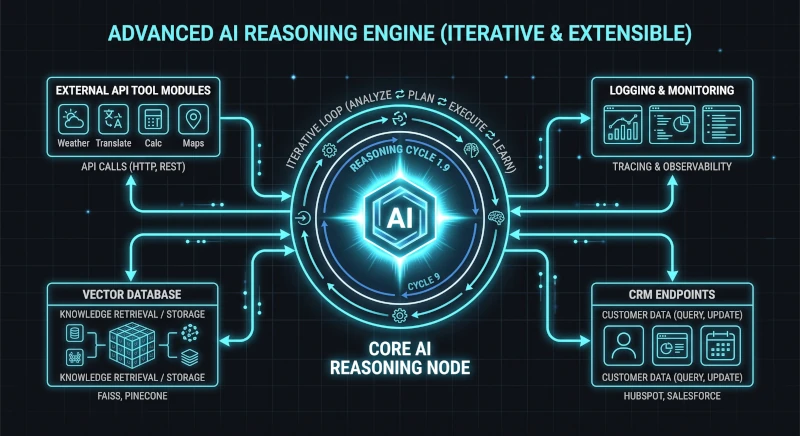
Our highest-performing technical analysis explored the shift from static conversational chatbots to dynamic agentic execution loops. But for agency architects and SaaS operators, a critical question remains: Where do these autonomous agents actually run?
Deploying custom LLMs inside isolated python scripts or relying on closed parent CRM ecosystems often leads to platform lock-in and high infrastructure costs. To achieve true operational leverage, modern engineering teams are building Autonomous Agentic Loops inside Decoupled Middleware.
Rather than utilizing middleware merely for linear data relaying (Zapier-style “If This Then That”), advanced operations teams use middleware platforms as the execution runtime for autonomous AI reasoning loops.
The Paradigm Shift: Linear Automations vs. Agentic Loops
To evaluate backend middleware in 2026, directory managers and agency leads must distinguish between traditional workflows and agentic loops:
- Linear Workflows (Traditional): A deterministic, hardcoded pipeline. Event A triggers Webhook B, which writes to Database C. If data is missing or malformed, the execution fails.
- Agentic Execution Loops (Autonomous): A non-linear decision loop. An LLM agent is given a goal, a set of available API tools (web search, CRM lookup, scraping actor, email parser), and an evaluation loop. The agent autonomously plans, executes, evaluates the result, and loops until the goal is achieved.
| Architectural Parameter | Linear Middleware Pipeline | Autonomous Agentic Middleware Loop |
| Logic Structure | Deterministic / Hardcoded paths | Dynamic / Reasoning-based execution loops |
| Error Handling | Throws exception; requires manual retry | Self-correcting; re-prompts or selects alternative API tools |
| API Consumption | Fixed 1-to-1 operation cost | Dynamic multi-step tool calls per execution cycle |
| Data Sovereignty | Usually vendor-managed cloud | Requires fair-code or self-hosted options for privacy |
Benchmark Highlight: n8n & Fair-Code Runtimes
When architecting high-frequency agentic loops, cloud-native per-task pricing models can quickly ruin profit margins. A single agentic loop might invoke 10 sub-tool calls before completing a task, consuming thousands of operations daily.
This operational challenge makes n8n a primary benchmark in the middleware disrupter space. Webpopulous listing for n8n.
As an extendable, fair-code platform, n8n allows technical teams to host the middleware engine on their own cloud infrastructure (AWS, DigitalOcean, or private servers). Key capabilities include:
- Native AI Agent Nodes: Direct LangChain and vector database integrations built natively into the visual node workflow builder.
- Custom Code Execution: Injects custom JavaScript or Python scripts directly within the loop to sanitize JSON arrays before passing payloads back to the LLM.
- Zero Per-Operation Tax: Running self-hosted instances means agencies pay for raw server compute rather than paying per individual API step, making high-volume agentic loops financially viable.
Key Evaluation Criteria for Agentic Middleware Runtimes
Before choosing an automation or middleware platform to host your agency’s AI agents, evaluate these technical criteria:
- Tool Calling & Schema Handling: Verify that the middleware natively supports OpenAI, Anthropic, or open-source Function Calling/Tool Calling protocols.
- Self-Hosting vs. Cloud Privacy: Confirm whether client data payloads touch external vendor databases or remain strictly within your sovereign server boundary.
- Memory & Vector Persistence: Ensure the platform can maintain state across asynchronous webhook execution cycles.
Engineering Your AI Backend
Transitioning from simple linear triggers to autonomous agentic loops allows digital agencies to deliver unprecedented operational efficiency. To compare entry costs, self-hosting capabilities, and API parameters across top middleware platforms and utility tools, explore our updated comparison matrices on WebPopulous.
Leave a Comment