

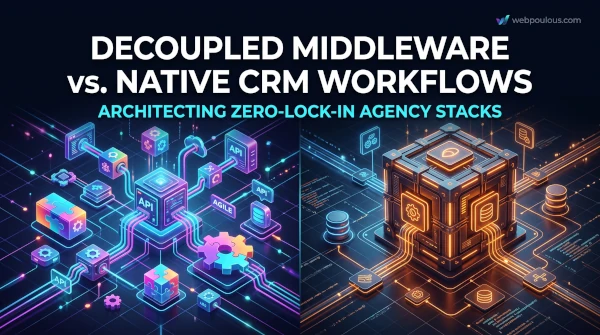
Building your agency’s operational logic directly into your CRM feels efficient on day one, but it is the fastest route to vendor lock-in. When technical founders and automation engineers evaluate their tech stacks, the decision of where the “brain” of the operation lives—inside the CRM or inside an independent middleware layer—dictates the long-term agility of the entire business.
During Week 3 of the WebPopulous taxonomy rotation, we are auditing Third-Party Integrations & Standalone Utilities. As a WebPopulous Directory Architect, I see operators consistently trap themselves in expensive ecosystems because they fail to separate their database layer from their execution logic.
Here is the architectural breakdown of native workflows versus decoupled middleware, and how to build an agency stack that you can actually migrate without breaking your business.
The Vendor Trap: Native CRM Workflows
Modern all-in-one CRMs (like HubSpot, ActiveCampaign, or GoHighLevel) aggressively push users toward their native automation builders. You map a trigger (“Tag Added”) to an action (“Send Email” or “Update Pipeline Stage”) entirely within their proprietary user interface.
The Architectural Reality:
- High Convenience, High Risk: Native workflows are fast to deploy because the data schema is pre-mapped. You do not have to authenticate APIs or parse JSON payloads.
- The Lock-In Tax: By building 150 complex client onboarding and lead-routing sequences inside the CRM, the CRM ceases to be just a database; it becomes your operational source code. If the vendor doubles their pricing, or if your agency outgrows their feature set, migrating away requires completely rebuilding your core operational logic from scratch. You are fundamentally trapped.
- Limited Error Handling: Native builders frequently lack robust error-catching and fallback routes. If a native third-party integration fails silently, the workflow often breaks without alerting the admin.
The Zero-Lock-In Model: Decoupled Middleware
Decoupled architecture removes the logic layer from the CRM entirely. Instead of using the CRM to route data, you treat the CRM strictly as a dumb ledger (a place to store names, pipelines, and notes). The actual decision-making and data routing happen in a dedicated middleware orchestration layer like Make (Integromat), n8n, or Zapier.
The Architectural Reality:
- Unbundled Sovereignty: If you use Make or n8n to listen for a new Stripe payment, generate a contract via an API, and push the final record into your CRM, the CRM is just the final destination. If you decide to migrate from HubSpot to Close CRM tomorrow, you simply swap out the final node in your middleware sequence. The core automation logic remains completely intact.
- Granular Webhook Control: Middleware platforms allow you to intercept raw HTTP requests, parse complex arrays, and iterate through line items natively.
- Resilient Infrastructure: Dedicated middleware platforms offer detailed execution histories, automated retry schedules for failed API calls, and custom error-handling branches.
Evaluating the Trade-Offs
When comparing these approaches in the Master Data Matrix Comparison Engine Tables, technical operators must weigh integration depth against structural flexibility.
| Architectural Dimension | Native CRM Workflows | Decoupled Middleware (Make, n8n, etc.) |
| Data Sovereignty | Low. Logic is owned by the CRM vendor. | High. Logic is independent of the endpoint databases. |
| Migration Friction | Severe. Logic must be rebuilt manually upon exit. | Minimal. Only the endpoint nodes need API re-authentication. |
| API Rate Limit Risk | Low. Internal CRM routing bypasses external API limits. | Moderate. Heavy middleware usage can trigger endpoint rate limits. |
| Maintenance Complexity | Simple. Managed entirely within a single UI. | Advanced. Requires monitoring webhook health and API token expirations. |
If you are scaling a multi-tenant agency, decoupling your logic is no longer optional—it is a baseline requirement for survival. When assessing new vendors for your stack, rely on the WebPopulous Matrix Technical Specs to verify if a platform offers unrestricted webhook access and bi-directional API capabilities, ensuring they can connect cleanly to your middleware layer rather than forcing you into their walled garden.
Leave a Comment