

Introduction
In the initial architecture of any digital ecosystem, all-in-one platforms often dominate the conversation. By bundling CRM systems, landing page builders, invoicing tools, and support desks into a single software environment, these structural behemoths offer undeniable convenience.
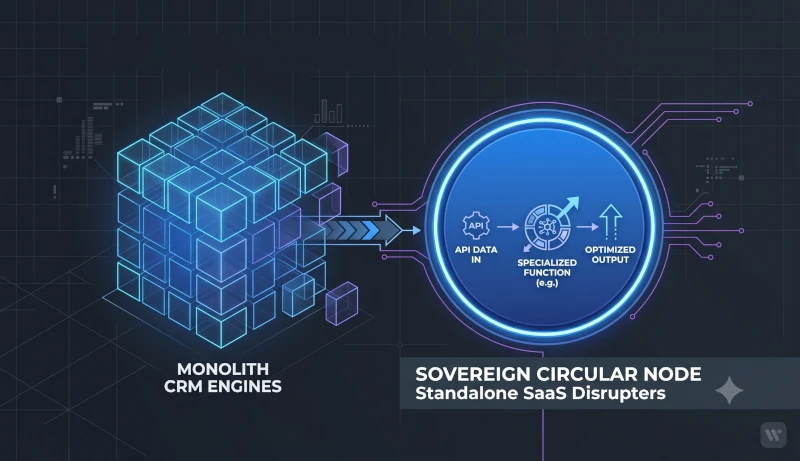
Yet, as markets mature, a clear operational pattern emerges: broad feature aggregation often comes at the cost of vertical depth. This friction has fueled the rise of Standalone Functional Alternatives—agile, independent platforms designed to unbundle the monolith by doing one core job exceptionally well.
What is a Niche Disrupter?
Within a B2B directory taxonomy, a software item’s classification is defined by its infrastructure dependency. Unlike a wrapper extension, which must plug into an active parent framework API to compute data, a standalone alternative operates entirely on its own sovereign codebase.
These platforms target specific core utilities within a broader suite—such as automated email behavioral triggers, deep financial revenue reporting, or complex customer journey routing—and optimize the performance of that single silo. To analyze how structured data pipelines isolate independent modules from nested framework loops, review the engineering workflows outlined via the WordPress Core Software Architecture Repository.
The Architecture of Choice: Monolith vs. Standalone
Choosing between a bundled parent system and a highly specialized standalone alternative requires evaluating core database speed, user experience bottlenecks, and feature depth:
| Operational Metric | Integrated Monolith Engines | Standalone Functional Alternatives |
|---|---|---|
| Infrastructure Overhead | Single login, unified database schema, zero external Webhook integration points required. | Isolated database infrastructure; requires dedicated API tokens to synchronize peripheral stacks. |
| Feature Depth | Wide feature surface area with basic configuration options per tool. | Hyper-focused utility layers featuring granular conditional logic, predictive pathing, and deep reporting. |
| System Freedom | High lock-in risk; migrating off the platform requires rebuilding your entire business operational core. | High modularity; the individual tool can be swapped out via webhooks without breaking adjacent infrastructure. |
The Power of Granular Logic
The primary weapon of the standalone disrupter is the elimination of feature dilution. When an application focuses exclusively on a pipeline like customer experience automation (CXA), it can allocate all computing resources toward perfecting that interaction loop.
Instead of basic data fields, an independent alternative can run background machine-learning checks to calculate ideal contact engagement windows, execute multivariate path split tests mid-funnel, and maintain highly isolated mail-server reputations. For software registries, highlighting these deep operational advantages ensures users can accurately weigh raw tool power against all-in-one convenience.
Conclusion
The B2B software market is a shifting pendulum that swings between aggregation and specialization. While all-in-one parent architectures provide an unmatched foundation for rapid launch and scale, standalone functional disrupters offer the structural depth required for high-performance operations. For modern database registry architects, categorizing these tools transparently ensures that software buyers can engineer highly custom, predictable, and resilient technical stacks.

Leave a Comment