

The Architectural Blueprint: Why Massive Systems Isolate Core Data (And Why You Should Too)
When we look at massive enterprise platforms like GoHighLevel, Salesforce, or large-scale multi-tenant directories, we aren’t looking at a single massive database. We are looking at a masterfully engineered separation of concerns.
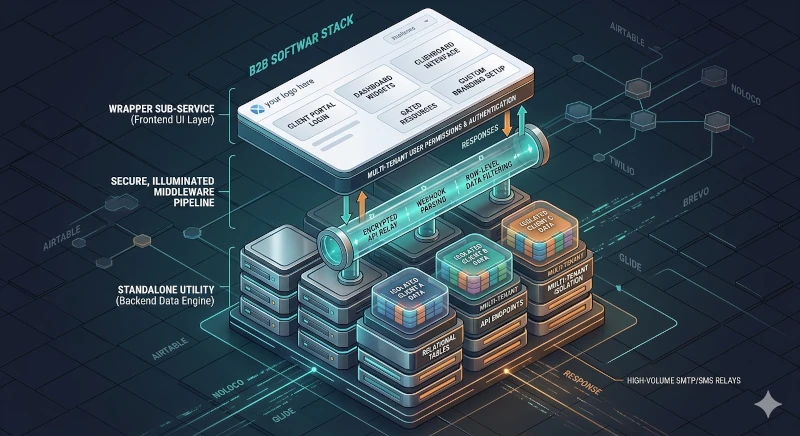
In high-scale systems, the software that generates and manages data is structurally isolated from the software that serves that data to the public. This architectural pattern—known in enterprise circles as Master Data Management (MDM) coupled with a Decoupled Delivery Layer—is the exact conceptual model that informs how modern, secure web portals should be engineered.
If you are planning to build a private administration portal or a vendor/advertiser directory, understanding how these giants handle data is crucial before writing a single line of code.
The Architecture: How Enterprise Systems Segment Data
Enterprise platforms do not let their public front-end applications talk directly to their primary system of record. Doing so introduces catastrophic bottlenecks, security vulnerabilities, and data corruption risks. Instead, they divide their infrastructure into distinct layers:
[ Primary System of Record ]

Private Admin Staging - Data Scrubbing - High-Performance CDN

---> (Strict Validation Engine)

Heaviest Database Load - Translation & Mapping - Read-Only Database

---> [ Public Delivery Layer ]

Active User Management - Asynchronous Webhooks - Fast, Un-gated Sear
- The System of Record (The Private Admin): This is the “Vault”. It handles heavy operations: payment processing, membership verification, raw content drafts, media uploads, and vendor management. It is locked behind strict authentication and is entirely invisible to standard web traffic.
- The Public Delivery Layer (The Live Site): This is the “Teller Window”. It is built for raw, blazing-fast speed. It doesn’t process business logic, run heavy membership checks, or allow write access to the core database. It simply receives verified, pre-approved “snapshots” of data and displays them to the world.
Why the “Single Monolithic Database” is a Trap
In traditional monolith applications (like standard out-of-the-box WordPress setups), everything lives in one database. Your public visitors, your premium members, your payment logs, and your active blog posts share the exact same physical space.
For a simple blog, this is fine. For an ecosystem involving vendors, advertisers, and public directory listings, it is a ticking technical debt bomb:
- The Performance Penalty: Every time a public user runs a search query on your live site, they compete for database connection pools with your vendors who are updating thousands of data points or uploading heavy media in the backend.
- The Auto-Increment Collision: If your live site dynamically generates content while your admin portal is also creating listings, sharing a database table will eventually lead to ID collisions, broken relational metadata, and synchronization nightmares.
- The Security Blast Radius: If an attacker finds a vulnerability in a public-facing plugin on your live site, they instantly gain a direct path to your private vendor contracts, advertiser billing profiles, and internal administrative logs.
Implementing the Enterprise Pattern on a Micro-SaaS Scale
You don’t need a multi-million dollar AWS infrastructure budget to implement these parent architecture principles. If you are building a private admin space (for example, hosting a staging dashboard on a dedicated subdomain), you can execute this split cleanly using three rules:
Rule 1: Treat the Private Admin as the “Single Source of Truth”
Your private subdomain is where master data is born, edited, and housed. It holds the master “Golden Records”. The public site owns nothing; it merely mirrors what the private admin explicitly pushes to it.
Rule 2: Decouple Using Unique Identifiers (UUIDs)
Never rely on auto-incrementing database IDs to map records between your admin and live site. If a listing is ID 42 in your private database, it might become ID 1008 on your live site depending on when it was pushed. Instead, generate an immutable, unique string (a UUID) on creation in the admin. Use this UUID as the anchor key to find, update, or delete the record across your environments.
Rule 3: Push, Don’t Pull (Asynchronous Relays)
The live site should never query the private admin database to check for updates. Instead, use an event-driven webhook structure. When an administrator marks a vendor listing as “Approved,” the admin site fires a secure, background POST payload containing the clean data directly to a custom REST API endpoint on the live site. The live site writes it locally, flushes its page cache, and remains completely decoupled.
The Architectural Takeaway: By separating the “Engine” (where your vendors work and pay) from the “Display” (where your public audience searches), you protect your business logic, isolate security threats, and ensure your public-facing platform loads with absolute zero database friction.
Leave a Comment