

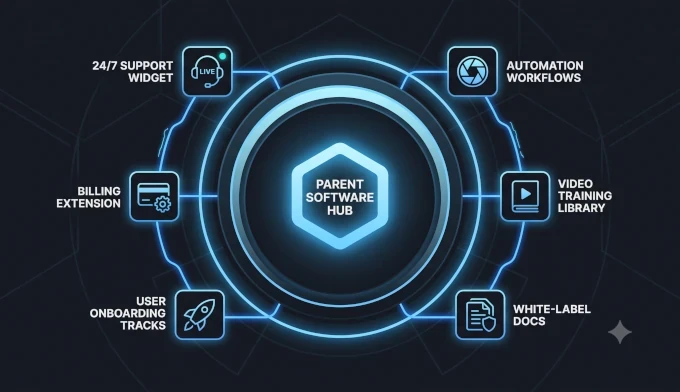
Evaluating the modern B2B SaaS landscape requires agency leaders to look beyond standalone software and understand how modular layers interact. In our opening matrix breakdown, we explored Foundational Parent Infrastructure Hubs like GoHighLevel, which provide the core database, CRM engines, and multi-tenant frameworks required to run an agency enterprise.
However, running a massive parent system introduces an operational hurdle: fulfillment overhead and customer support friction. While parent architectures offer powerful toolsets, onboarding end-clients and maintaining technical support can quickly overwhelm growing agencies. This operational gap has birthed one of the most lucrative categories in the B2B registry landscape: Wrapper Sub-Services & Extensions.
What is a Wrapper Sub-Service?
A Wrapper Sub-Service (or micro-SaaS extension layer) is a specialized application built directly on top of a foundational parent architecture. Rather than competing with parent hubs, wrapper extensions enhance them by filling targeted vertical gaps—such as specialized industry snapshots, custom webhooks, automated UI enhancements, or 24/7 white-labeled end-user support.
By unbundling labor-heavy support tasks into dedicated wrapper environments, software resellers and agency owners isolate their core operational team from daily ticket management while maintaining complete brand sovereignty.
Benchmark Highlight: HL Pro Tools
A prime operational benchmark in the extension category is HL Pro Tools, a micro-SaaS optimization engine designed explicitly for agencies leveraging GoHighLevel.
Instead of forcing agency leaders to hire round-the-clock technical support staff or manually record hundreds of software tutorial videos, HL Pro Tools plugs directly into the parent platform’s dashboard. It provides:
- Embedded 24/7 Live Support: Instant live chat and ticket assistance served under the agency’s native white-label branding.
- Turnkey Industry Snapshots: Pre-configured sales funnels, email sequences, and automation pipelines built for specific vertical markets.
- Interactive Knowledge Bases: In-app video tutorials and step-by-step documentation dynamically updated as the parent CRM evolves.
By deploying a sub-service layer like HL Pro Tools, agency owners transform an off-the-shelf software instance into a fully managed, high-retention SaaS platform.
Key Evaluation Criteria for Extension Layers
Before integrating a sub-service or wrapper tool into your primary software stack, analyze these critical metrics:
- Rebranding Depth: Verify that the extension offers 100% white-label isolation so end-users never see third-party vendor watermarks or domain redirects.
- Multi-Tenant Compatibility: Ensure the tool dynamically applies settings across all sub-accounts without manual API re-configuration.
- Impact on Churn Rates: High-touch support layers directly correlate with higher client retention and lower software churn.
Cutting Through the Software Noise
By layering dedicated wrapper sub-services onto proven parent platforms, modern agencies achieve true operational leverage. To compare features, entry costs, and white-label capabilities across top CRM extensions and micro-SaaS layers, explore our updated comparison matrices on WebPopulous.

Leave a Comment