

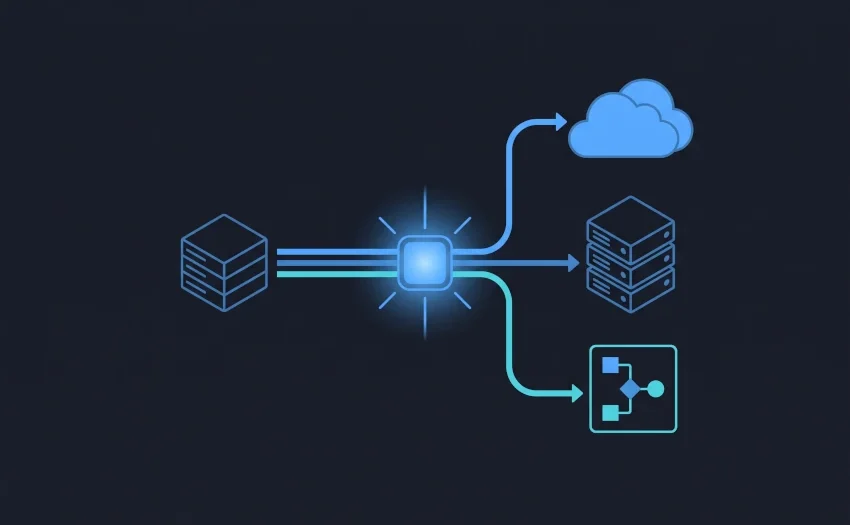
Every digital agency eventually hits a technical fork in the road: your client database relies on one system, your communication stack lives in another, and your AI processing runs on an external model. Without a dedicated layer to bind them, agency teams burn hundreds of hours manually copying payloads or writing fragile custom REST API scripts.
Enter AI Automation Middleware—the unbundled, visual data highways that sit between your applications, catch incoming webhooks, process data using LLMs, and route actionable updates across your software stack.
However, evaluating middleware is no longer as simple as picking the platform with the most logos. Today, agency architects must weigh structural trade-offs across three primary paradigms: Accessibility (Zapier), Data Sovereignty (n8n), and Visual Logic Processing (Make.com).
1. Cloud Accessibility: Zapier
For teams prioritizing speed to market over granular data engineering, cloud-native platforms like Zapier set the standard. With thousands of pre-built integrations, Zapier enables non-technical account managers to launch automated AI steps in minutes.
- The Trade-Off: High convenience comes with rigid task-metering costs. High-volume agencies executing millions of background webhook checks per month can quickly see operational margins eroded by per-step task pricing.
2. Total Data Sovereignty: n8n
When handling client data subject to strict privacy rules or managing high-frequency API traffic, self-hosted fair-code options like n8n offer an unbeatable infrastructure layer. Because n8n can be deployed directly onto your own private cloud servers, data payloads never touch a third-party vendor’s intermediate database.
- The Trade-Off: Complete data control requires dedicated DevOps management. Your team must manage server uptime, scale container instances, and handle API rate limits independently.
3. Visual Scenario Logic: Make.com
Sitting directly between simplicity and total server ownership is Make.com. Built around a visual node canvas, Make.com excels at handling complex multi-branch arrays, JSON aggregations, and usage-based operations credit models.
- The Trade-Off: While it offers exceptional cost efficiency for complex data manipulation, the visual scenario builder carries a steeper learning curve for non-technical team members compared to linear workflow tools.
Evaluating Middleware for Your Stack
| Technical Variable | Zapier (Cloud Convenience) | Make.com (Visual Logic Engine) | n8n (Fair-Code Self-Hosted) |
| Data Hosting | Cloud (Managed) | Cloud (Managed) | Self-Hosted / On-Prem / Cloud |
| Pricing Model | Per-Task Tiering | Per-Operation Metering | Free Community / Self-Hosted Tiers |
| Target User | Operations & Non-Tech Teams | Integration Architects & Devs | DevOps & Engineering Teams |
| Data Privacy | Vendor Cloud Processing | Vendor Cloud Processing | 100% Private Server Sovereignty |
Standardize Your Middleware Architecture
Whether you need zero-maintenance cloud simplicity or complete server sovereignty, selecting the right middleware dictates how fast your agency can scale. To compare entry costs, sub-billing mechanics, and multi-tenant capabilities across top platforms, explore our updated AI Automation Middleware comparison matrix on WebPopulous.
Leave a Comment