

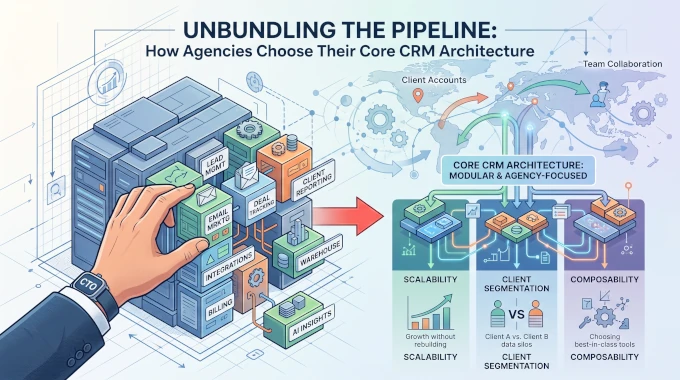
For digital agencies and scaling B2B teams, the Customer Relationship Management (CRM) platform is the central nervous system of the entire business. It holds your primary contact records, tracks active revenue opportunities, and executes automated deal progressions.
However, searching for an “All-in-One CRM” today reveals a massive structural divide. Platforms that share the same high-level category tag in a generic review site often operate on completely different database philosophies under the hood.
At WebPopulous, we unbundle these platforms by analyzing raw operational mechanics, data hygiene capabilities, and infrastructure trade-offs.
Here is how the four primary paradigms in the All-in-One CRM & Sales Pipelines category map out for technical agency builders.
1. The Enterprise Sovereign Hub: HubSpot
For mid-market agencies and scaling organizations prioritizing data hygiene above all else, HubSpot represents the sovereign, single-codebase benchmark.
Unlike suites assembled through corporate acquisitions, HubSpot’s marketing, sales, and service hubs write directly to the exact same core contact tables. This removes background sync latency and eliminates fragile webhook routing.
- The Trade-Off: Enterprise governance and open developer sandbox access come at a premium cost as your database contacts scale.
2. The Customer Experience Automation Engine: ActiveCampaign
When an agency’s primary revenue model relies on complex, behavior-triggered customer journeys and multi-channel email sequencing, ActiveCampaign serves as a specialized functional disrupter.
It trades broad, enterprise-wide feature bloat for deep predictive pathing, multivariate funnel split testing, and high-deliverability email server infrastructures.
- The Trade-Off: While its conditional automation builder is industry-leading, its native pipeline deal management features are leaner compared to dedicated outbound dialers.
3. The High-Velocity Outbound Engine: Close CRM
For sales-driven agencies, SDR teams, and outbound deal closers who spend their entire day making calls and sending transactional SMS sequences, traditional CRMs feel slow and overly complex.
Close CRM strips away broad marketing fluff to focus entirely on an inner-loop sales layout. It embeds automated calling, voicemail drops, and two-way SMS directly inside the deal pipeline card.
- The Trade-Off: It is a pure-play sales execution engine; top-of-funnel inbound landing page creation and heavy content marketing must be offloaded to external utilities.
4. The European Operations & Invoicing Alternative: Flowii
For European operators and regional agencies requiring native localized compliance, Flowii provides a lightweight, unbundled alternative combining core CRM pipelines with built-in attendance tracking, warehouse management, and local invoicing mechanics.
- The Trade-Off: It targets regional operational clarity rather than deep, global API developer ecosystems or complex machine-learning attribution models.
Architectural Comparison Matrix
| Technical Variable | HubSpot | ActiveCampaign | Close CRM | Flowii |
| Core Architecture Focus | Sovereign Unified Database | Behavior-Driven Automation | High-Speed Outbound Execution | Regional CRM & Operations |
| Native Telephony / SMS | Add-on / API Integration | Third-Party Webhook Relays | Native Built-in Dialing & SMS | Basic Native Messaging |
| Primary Target User | Scaling Mid-Market / Enterprise | Growth Marketers & Agencies | Outbound SDRs & Sales Teams | European SMBs & Local Services |
Deploying the Right Matrix Node
Choosing the right CRM isn’t about finding the tool with the most features listed on a marketing page—it’s about matching software mechanics to your team’s real-world operational bottlenecks.
Explore our updated All-in-One CRM & Sales Pipelines comparison matrix on WebPopulous to filter by entry costs, multi-tenant rules, and true white-label capabilities before committing your agency’s data infrastructure.
Leave a Comment