

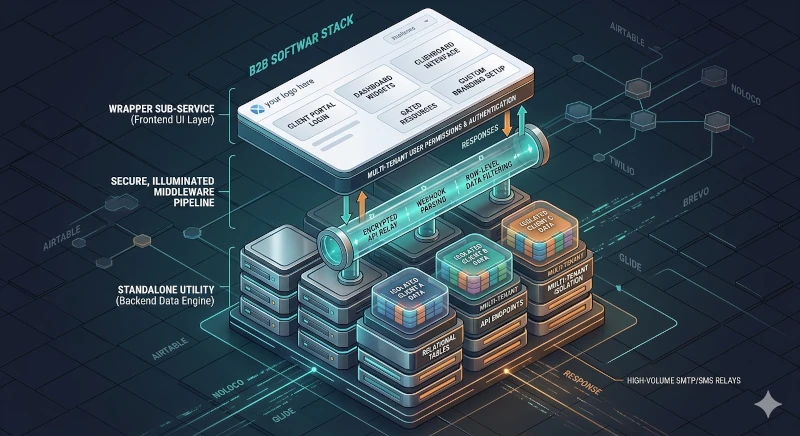
When engineering a modern agency or B2B SaaS tech stack, the architectural choices you make today will directly dictate your profit margins tomorrow. In our continuous breakdown of the WebPopulous Directory, we have unbundled heavy, monolithic software suites into modular components. But as agencies move away from rigid, all-in-one CRMs, they face a critical architectural fork in the road.
It is what we call The Great Middleware Debate: Should you build your system using Third-Party Integrations & Standalone Utility Vendors, or deploy a highly polished Wrapper Sub-Service or Extension?
While these two categories share space on our responsive comparison grids, they serve entirely opposite structural philosophies. Mixing them up doesn’t just create messy documentation—it creates catastrophic bottlenecks in data isolation, user permissions, and overhead cost scaling.
Here is the deep-dive engineering blueprint on how these two categories interact, where their boundaries lie, and how to deploy them in a production environment.
The Architectural Definitions: Pure Engines vs. Presentation Layers
To deploy these tools effectively, you must understand where the code executes and who owns the database state.
1. Third-Party Integrations & Standalone Utility Vendors (The Engines)
- The Structural Rule: They own their own independent, highly optimized relational databases or infrastructure arrays.
- The Purpose: They are engineered to do one heavy-lifting task at an elite, enterprise level (e.g., storing million-row relational datasets, executing programmatic telecom relays, or passing high-volume SMTP mail tokens).
- The Ecosystem Fit: They are framework-agnostic. They connect via raw REST or GraphQL APIs and webhooks. They do not care about your frontend branding because they run silently as background processes.
- Paradigm Examples: Airtable, Twilio, Brevo.
2. Wrapper Sub-Services & Extensions (The Frontends)
- The Structural Rule: They do not own a native underlying master database. If you disconnect them from an external data source, they become an empty shell.
- The Purpose: They act as a secure, visually pristine presentation layer. They wrap around an existing database or a parent architecture to provide full user authentication, custom CSS layouts, and client-facing dashboards.
- The Ecosystem Fit: They solve the “Fake White-Label” problem. They take raw, unbranded technical engines and mask them under your agency’s custom domain, custom brand guidelines, and unique pricing tiers.
- Paradigm Examples: Softr, Noloco, Glide.
The Core Interaction: How They Build a Modular Enterprise
The magic of the WebPopulous twelve-category matrix happens when you stop viewing these categories as competing options and start viewing them as stacked dependencies.
In a modern, unbundled architecture, you couple a Standalone Utility directly underneath a Wrapper Sub-Service. This allows you to build enterprise-grade software applications at a fraction of the cost of traditional full-stack coding.
┌────────────────────────────────────────────────────────┐ │ WRAPPER SUB-SERVICE (Visual & Permission Layer) │ │ Manages: Multi-Tenant Login, Custom Branding, UI │ └───────────────────────────┬────────────────────────────┘ │ Secure API Relay / Webhooks ┌───────────────────────────▼────────────────────────────┐ │ STANDALONE UTILITY VENDOR (Data & Processing) │ │ Manages: Relational Tables, Data States, API Sharding│ └────────────────────────────────────────────────────────┘Consider how a modern real estate agency or programmatic lead-generation firm scales using this explicit stack configuration:
- The Backend (Utility): The agency uses Airtable to hold thousands of complex property records, matching coordinates, and sensitive agent commission data. It is fast, secure, and handles raw relational logic perfectly—but you cannot give clients direct access to it without exposing your entire backend operation.
- The Frontend (Wrapper): The agency places Softr or Noloco directly on top of that Airtable base. The wrapper handles user authentication. When a client logs in, the wrapper queries the backend utility using strict row-owner security filters, rendering a beautifully white-labeled UI showing only that specific client’s properties.
Evaluating the Metrics: Filtering Your Next Deployment
When scouring the WebPopulous directory to choose between expanding your stack with an independent utility or masking it with a wrapper extension, filter your decisions through three strict technical variables:
1. Data Isolation Logic
If you are building an application where multiple external clients will log in to view their respective data assets, a Wrapper Sub-Service is mandatory. Standalone utilities excel at bulk storage, but they lack the granular, user-session-based interface routing required to safely isolate multi-tenant user visibility profiles.
2. Overhead Scaling & Billing Sovereignty
- Utility Scaling: Standalone utility vendors typically bill based on raw data footprint metrics—number of database records, API call volume, or messages processed.
- Wrapper Scaling: Wrapper extensions typically charge flat fees based on application seats or domain limits.
The Strategy: By keeping your data decoupled, you can scale your data repository linearly inside a utility vendor without being forced into an aggressive, expensive enterprise software tier on your frontend presentation layer.
3. The Migration Boundary
Always design your stack with an exit strategy. Because Standalone Utilities give you raw, unthrottled access to your data tables via JSON or bulk CSV streams, your data remains completely sovereign. If a frontend Wrapper changes its pricing matrix or discontinues a UI feature you rely on, your core database remains unharmed. You can simply unhook the wrapper, swap it out for a different extension vendor on our matrix grid, and remap your API custom fields without losing a single line of business data.
The Verdict: Architect with Intention
An elite agency operations engineer never asks, “Which tool is better?” They ask, “Which layer of my software architecture am I currently building?”
If you need to optimize raw performance, maximize email deliverability, or store complex data states, choose an asset from our Third-Party Integrations & Standalone Utility Vendors category. If you need to build a secure, beautifully masked, multi-tenant home for your clients or internal teams to interact with that data, map an option from our Wrapper Sub-Services & Extensions category.

Leave a Comment