

In the early days of the B2B SaaS boom, software companies raced to build “all-in-one” ecosystems. The goal was simple: lock a business into a single application that handled their database, their workflows, and their user interface.
But as the market matured, technical agency operators, operations managers, and developers realized a glaring flaw in the all-in-one approach. When a single platform tries to do everything, it rarely does any one thing at an elite level. Your database might be incredibly powerful, but its client-sharing portal looks like a sterile spreadsheet. Your CRM might hold millions of customer profiles, but its customer-facing layout lacks the clean branding your agency requires to maintain authority.
This operational friction birthed a massive, high-margin layer of the WebPopulous Taxonomy: Wrapper Sub-Services & Extensions.
Defining the Wrapper Sub-Service Architecture
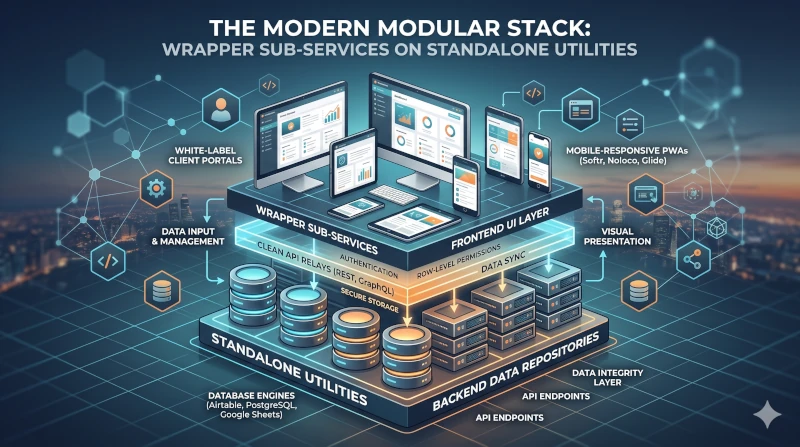
In a modular software stack, a Wrapper Sub-Service (often referred to as a frontend wrapper or an application extension) is software that does not own its own underlying relational database. Instead, it is an specialized interface layer engineered to sit directly on top of a separate, independent database or a foundational parent architecture.
To understand how this operates in production, think of your software stack like a modern house:
- The Foundation & Utilities (The Backend): This is where your data lives. It is raw, structured, and heavy—managed by standalone utility engines like Airtable, PostgreSQL, or Google Sheets.
- The Exterior Architecture (The Wrapper): This is what the world actually sees. It is the secure, branded, and beautifully designed user interface (UI) layer—built using tools like Softr, Noloco, or Glide—that safely exposes that backend data to clients and internal teams without leaking the raw database structure.
┌────────────────────────────────────────────────────────┐ │ WRAPPER SUB-SERVICE (Frontend UI Layer) │ │ (e.g., Softr, Noloco, Glide) │ └───────────────────────────┬────────────────────────────┘ │ Real-Time API / Sync Relay ┌───────────────────────────▼────────────────────────────┐ │ STANDALONE UTILITY (Backend Data Engine) │ │ (e.g., Airtable, PostgreSQL, Hosted SQL) │ └────────────────────────────────────────────────────────┘How Wrappers Solve the “Fake White-Label” Problem
For digital agencies and B2B SaaS product teams, the primary driver behind adopting frontend wrappers is brand sovereignty and security.
While many standalone databases allow you to “share a link” with a client, doing so exposes the software vendor’s native branding, limits your design control, and creates massive security risks regarding row-level permissions. If a client logs in and sees a third-party software logo, your perceived value as a high-end tech provider drops instantly.
Wrapper sub-services solve this by establishing an absolute wall between the user and the data:
- Granular Permissions: A wrapper ensures that when Client A logs into your portal, the frontend uses strict row-owner logic to query only Client A’s data records out of a master database containing thousands of records.
- True White-Label Sovereignty: Every button, font, color, domain name, and transactional login email is completely customized to match the agency’s brand identity—making the underlying database engine entirely invisible to the end user.
The Market Landscape: Three Dominant Wrapper Models
The wrapper ecosystem has diversified into highly specialized categories based on business operations. When mapping your stack in the WebPopulous directory, these platforms generally segment into three distinct use cases:
1. Client Portals & Public Directories (The “Lego Block” Model)
- The Paradigm Platform: Softr
- How it’s used: Best optimized for public-facing web directories, gated resource libraries, or lightweight client dashboards. It uses an incredibly fast component system where pre-built UI blocks hook directly into a database like Airtable or Google Sheets. It is the premier choice when deployment speed and crisp web presentation take priority over deep back-office calculations.
2. Back-Office Systems & Internal Tools (The “Relational Operations” Model)
- The Paradigm Platform: Noloco
- How it’s used: Engineered for complex internal operations, custom CRMs, and deeply integrated workflows. Unlike basic wrappers, these platforms excel at handling multi-source environments (such as reading from a marketing spreadsheet while simultaneously updating an enterprise PostgreSQL server). They provide advanced server-side action buttons and multi-role workflows built for teams managing heavy internal business logic.
3. Mobile-First Agile Applications (The “Progressive Web” Model)
- The Paradigm Platform: Glide
- How it’s used: Designed specifically to turn structured data arrays instantly into high-performance, mobile-responsive progressive web apps (PWAs). This model is heavily favored by field operations teams, inventory managers, and agency teams who need hardware-level access—like mobile geolocation mapping and camera-based barcode scanning—directly tied to their primary databases.
The Architectural Verdict
Understanding the relationship between Standalone Utilities and Wrapper Sub-Services is a superpower for modern web architects and agency owners. It allows you to build incredibly complex, enterprise-grade software experiences at a fraction of the cost of traditional, custom-coded software engineering.
By unbundling your data layer from your visual presentation layer, you gain the freedom to swap out your frontend design elements without ever breaking your underlying core database structure. When building out your business tech stacks, always ensure your backend utility and your frontend wrapper are perfectly aligned to protect your operations, your data integrity, and your bottom-line margin.

Leave a Comment